India’s Payments Growth Has Created a Data Operations Problem
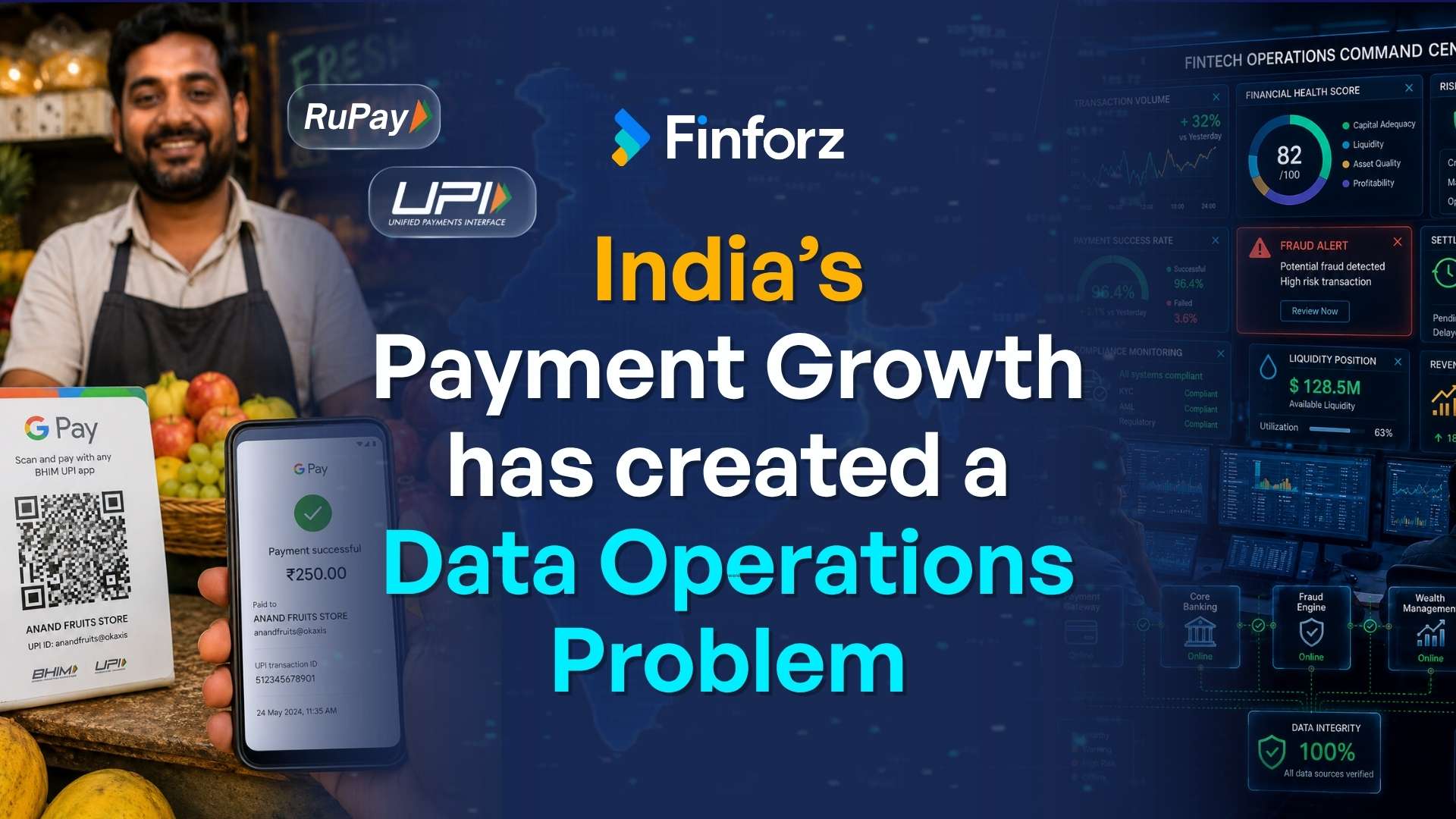
India's digital payments story is often described as a success story of scale. And rightly so.
UPI has transformed how India transacts from roadside Tea shops and Kirana stores to Enterprise merchants and Government collections. What once took minutes now happens in seconds.
But behind every successful payment lies something far less visible:
A growing operational burden on banks and payment ecosystems. As transaction volumes surge across UPI, RuPay, QR payments, payment gateways, and merchant ecosystems, banks are now facing a challenge that is no longer just about payments.
It is about data operations.
India's Payments Scale Is Growing Faster Than Operational Visibility
India's digital payments infrastructure is expanding at an unprecedented pace.
According to NPCI, UPI processed over 16.58 billion transactions worth ₹23.49 lakh crore in October 2024 alone, reflecting a 45% year-on-year growth. (Press Information Bureau)
UPI now accounts for nearly 70–80% of India's digital payment transactions, making it the operational backbone of the country's payments ecosystem. (Department of Financial Services)
From a consumer perspective, this looks seamless. But for banks and financial institutions, the operational complexity underneath has multiplied.
The Hidden Problem Behind Every Successful Transaction
Every UPI payment triggers multiple layers of operational activity:
- Transaction validation
- Routing and switching
- Settlement processing
- Reconciliation
- Fraud monitoring
- Regulatory reporting
- Exception handling
- Merchant visibility tracking
As transaction velocity increases, so does the volume of operational data flowing across systems.
The challenge is that many banks still operate with:
- Fragmented monitoring systems
- Separate reconciliation tools
- Manual reporting workflows
- Excel-based operational tracking
- Disconnected compliance visibility
This creates what many institutions are now experiencing:
Operational blind spots.
Payments Are Real-Time. Operations Often Aren't.
India's payments ecosystem has become real-time.
But many operational processes supporting those payments still are not.
A transaction may complete in seconds, while:
- Reconciliation happens hours later
- Exceptions are identified manually
- Reporting is delayed across systems
- Monitoring teams work reactively instead of proactively
At low scale, these gaps are manageable. At India-scale, they become operational risks.
A single mismatch across systems can affect:
- Merchant settlements
- Customer trust
- Compliance reporting
- Operational efficiency
And as RBI oversight around payment ecosystems continues to strengthen, operational visibility is becoming increasingly critical.
The Rise of Multi-Rail Complexity
The Indian payments ecosystem is no longer limited to one rail.
Banks today manage transactions across:
- UPI
- RuPay
- QR payments
- Payment gateways
- IMPS / NEFT / RTGS
- Merchant payment ecosystems
- AutoPay mandates
- Wallet integrations
Each rail generates different operational datasets, reporting formats, reconciliation flows, and compliance requirements.
The result?
More payments. More systems. More operational complexity.
Why Data Operations Is Becoming a Strategic Function
Historically, data operations was viewed as back-office infrastructure.
Today, it directly impacts:
- Payment reliability
- Merchant experience
- Compliance readiness
- Fraud visibility
- Decision-making speed
This shift is forcing banks to rethink operational intelligence.
The focus is no longer just: "Can we process payments?"
The real question is: "Can we monitor, reconcile, validate and understand payments at scale?"
Where DataFuze Fits In
This is where Finforz Technologies DataFuze becomes critical.
DataFuze is designed to help banks and financial institutions manage large-scale transaction environments through centralized operational intelligence.
Instead of relying on disconnected systems and manual processes, DataFuze enables institutions to unify operational visibility across the payments ecosystem.
What DataFuze Enables
Centralized Data Intelligence
DataFuze consolidates operational data from multiple banking and payment systems into one unified intelligence layer.
This provides:
- Real-time visibility
- Unified dashboards
- Cross-system monitoring
- Faster operational analysis
Automated Reconciliation
As payment volumes increase, reconciliation complexity grows exponentially.
DataFuze helps banks automate:
- Transaction matching
- Exception detection
- Settlement validation
- Multi-rail reconciliation workflows
Reducing manual intervention significantly.
Real-Time Monitoring & Alerts
Instead of discovering issues after settlement cycles, DataFuze enables:
- Real-time operational monitoring
- Anomaly detection
- Transaction visibility
- Early risk identification
This helps operations teams move from reactive management to proactive control.
Regulatory & Compliance Visibility
With increasing RBI focus on digital payments governance, banks need stronger reporting and audit capabilities.
DataFuze supports:
- Structured reporting workflows
- Audit traceability
- Operational transparency
- Data validation processes
Helping institutions strengthen compliance readiness.
Scalable for India's Payment Growth
India's payments growth is not slowing down.
NPCI data shows UPI transaction volumes continue to break records month after month. (NPCI)
Banks need operational systems designed not just for current scale but future scale.
DataFuze is built for high-volume transaction environments where visibility, reconciliation, and operational intelligence become mission-critical.
The Future of Payments Isn't Just About Transactions
India has already solved digital payments adoption. Now the challenge is operational maturity.
As UPI, RuPay, and merchant ecosystems continue to expand, banks and financial institutions must strengthen the layer beneath payments:
- Monitoring
- Reconciliation
- Reporting
- Data visibility
- Operational intelligence
Because at India-scale, payments do not fail only because of infrastructure. They fail when operations lose visibility.
Final Thoughts
Consumers experience digital payments in seconds. Banks manage the operational reality behind those seconds.
The next phase of India's payment evolution will not be defined only by transaction growth.
It will be defined by how intelligently institutions manage the data behind that growth.
And that is exactly where DataFuze positions itself.